Truck Placement and Hose Reach: The Logistics of Drain Work in Diadema
Category : General
Truck Placement and Hose Reach: The Logistics of Drain Work in Diadema
The job starts with a truck that cannot park where it needs to. In Diadema’s denser neighborhoods, the vacuum or jetting vehicle often has to stop a block away, and everything that follows — hose length, pressure loss, crew timing, even the final cost — is shaped by that single constraint. If you are searching for a desentupidora Mauá or planning drain work in the ABC region, understanding access logistics helps you set realistic expectations and avoid surprises on the day of service.
This is not a sales pitch. It is an operational explainer for building managers, síndicos and property owners who want to know why a drain job takes the time it does. The same physical rules apply whether the blockage is in a kitchen line, a condominium stack or a street-level inspection box.
Why the Truck Is the First Decision, Not the Last
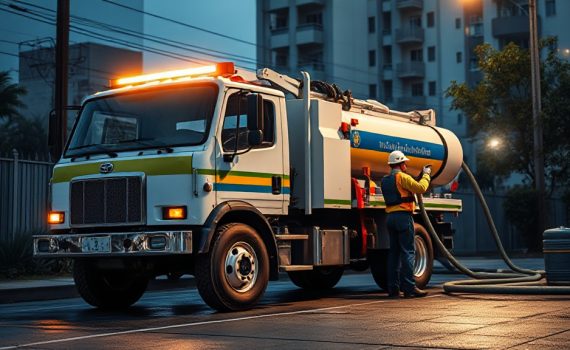
Every drain service in Diadema begins with a vehicle placement assessment. The equipment — high-pressure jetting units, vacuum tanks, hose reels — is heavy and needs a stable, level spot with enough clearance to operate safely. In narrow streets, steep gradients or areas with double-parked cars, that spot may be several dozen meters from the actual cleanout.
Operators evaluate three things before unrolling a single meter of hose: the distance to the access point, the vertical lift required, and whether the hose path crosses traffic, pedestrian zones or private property. Each factor adds time and reduces the effective working radius of the equipment.
Street width and turning radius
Many Diadema streets were laid out for lighter traffic and smaller vehicles. A jetting truck may need to reverse into position or use a wider cross street as a staging area. When the street is too narrow for the truck to turn safely, the crew may park farther away and carry equipment by hand — which is slower but often the only legal option.
Parking restrictions and time windows
Loading zones, bus stops and residential parking rules can limit where the truck can stand. In some cases, the crew must coordinate with building staff to reserve space or use a private driveway. A job scheduled for mid-morning may face different constraints than one at night, when streets are quieter but visibility is lower.
Hose Reach: The Invisible Cost of Distance
Hose length is not infinite, and neither is pressure. Every additional meter of hose adds friction loss, meaning the jetting nozzle delivers less force at the blockage. That is why a job that looks simple on paper — a blocked line just inside the property — can become a longer operation when the truck is parked far away.
Operators calculate reach in two dimensions: horizontal distance from the truck to the access point, and the depth or vertical run inside the pipe. A 30-meter horizontal run plus a 3-meter vertical drop can consume most of a standard hose reel’s practical working length, leaving little margin for maneuvering around bends.
Pressure loss and nozzle performance
High-pressure jetting relies on water volume and velocity to cut through grease, roots and sediment. When hose runs are long, the pump must work harder to maintain pressure at the nozzle. In some cases, the crew may use a larger-diameter hose or a different nozzle to compensate. This is a technical adjustment, not a shortcut — it affects how quickly the blockage clears.
When the access point is not where you think
Many properties have multiple cleanouts, inspection boxes or roof vents. The nearest access may not be the most effective one. A desentupidora Mauá SP crew will often test several access points to find the one that gives the best angle and shortest hose run, even if it means moving the truck or reconfiguring the setup.
A Worked Example: The Condominium on a Narrow Street
Consider a mid-sized condominium in a dense Diadema neighborhood. The building’s main sewer line backs up, and the cleanout is located in a small utility area behind the parking garage. The street in front is one-way with parked cars on both sides, and the only legal spot for a jetting truck is about 40 meters away, around a corner.
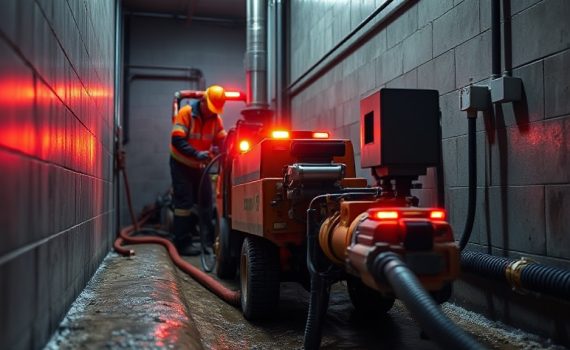
The crew arrives and immediately assesses the access. They cannot park in front of the building without blocking traffic, so they stage the truck on the cross street and run hose along the sidewalk, using protective ramps to keep pedestrians safe. The horizontal run is 40 meters, plus a 5-meter vertical drop to the cleanout. That is 45 meters of hose before the nozzle even enters the pipe.
Because of the distance, the operator selects a smaller-diameter hose to reduce friction loss and adjusts the pump pressure accordingly. The first pass clears a grease blockage near the cleanout, but the crew suspects a second obstruction farther down the line. They switch to a root-cutting nozzle and make a second pass, which takes additional time because the hose must be retrieved and re-fed.
Total job time: about three hours, compared with an estimated 90 minutes if the truck could have parked directly in front. The difference is not inefficiency — it is the physical reality of hose reach and safe truck placement. A desentupidora em Mauá SP team familiar with these neighborhoods plans for this extra time and communicates it upfront.
What Building Managers Can Do to Speed Up Access
You cannot widen a street, but you can remove obstacles that slow a crew down. Small preparations before the truck arrives often save more time than any equipment upgrade.
- Clear the path to the cleanout: remove stored items, parked bikes or furniture from utility areas and corridors.
- Reserve a parking spot: coordinate with neighbors or the building administration to keep a space free near the access point.
- Provide a site contact: someone who can open gates, explain the layout and confirm which cleanouts are active.
- Share photos in advance: a quick photo of the cleanout area and the street helps the dispatcher choose the right truck size.
These steps do not eliminate the physics of hose reach, but they reduce the number of trips between truck and access point. In dense neighborhoods, that can cut a job’s duration noticeably.
Planning for the Unavoidable: Time, Cost and Expectations
Logistics affect cost because they affect labor hours and equipment wear. A job that requires long hose runs, multiple access points or a second pass with a different nozzle will take longer and may use more water or fuel. Reputable providers explain these factors before starting, so you are not surprised by the final invoice.
If you are comparing quotes for drain work in Diadema, ask how the company handles access constraints. A provider that asks about street width, parking and cleanout location is thinking like an operator, not just a salesperson. That is usually a sign of realistic scheduling and fewer on-site surprises.
The next time a drain job takes longer than you expected, look at where the truck is parked. The distance from that spot to the blockage explains more than any other single factor. Good planning starts with accepting that constraint and working with it, not around it.